Agencies Valamar Quality Centre Groups

Island of Krk Culture & history

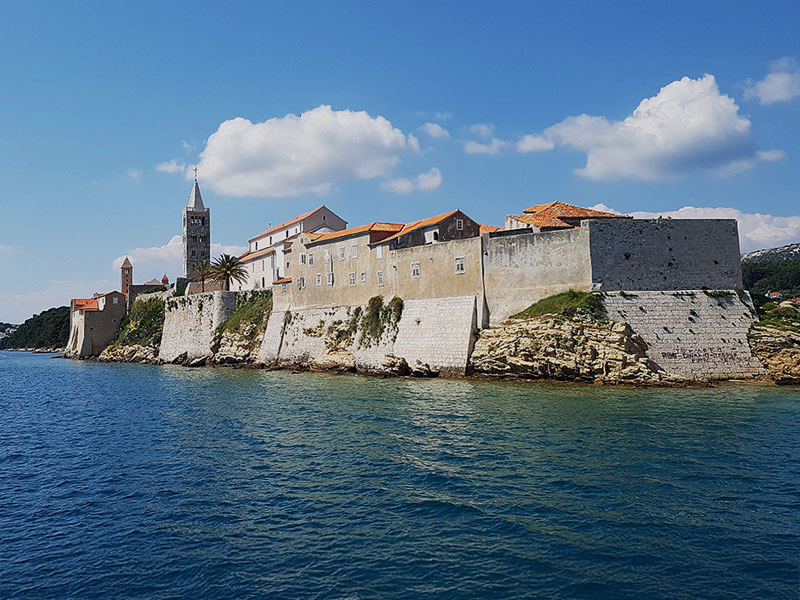
Splendidissima civitas Curictarum - The Glorious City of the People of Krk. This inscription is written on a 4th century Antique tombstone. This is how the town of Krk was described long ago, and in the main the old town centre has stayed like this up until the present day. Due to its natural riches, at the beginning of the first century the Romans called it the “Golden island” (Insula aurea).
In Roman times the main town on the island was Curicum (Krk). It had the strongest walls on the eastern coast of the Adriatic, and a large number artefacts from this period are spread all over the island. Culture and history are two words that are very applicable to the entire island.
In addition to the many sites of interest that you can find all over the island of Krk, there is also the fact that it is the literary cradle of the Croatian nation. Krk was one of the strongholds of Glagolitic culture in the Slav world. The Krk inscription is one of the first written examples from the 12th century, and the most famous memorial of Croatian language (1100) was found in Jurandvor near Baška. This was a gift from the Croatian King Zvonimir to the Benedictine monastery that was located there.
Here, we give a short history of Krk and an overview of its most important parts.
History

4 B.C.

The Japods, the first known inhabitants of Krk are expelled by the other Illyrian tribe – the Liburnians.

Around 9 A.D.

The arrival of the Romans.

5th and 6th centuries

The arrival of Christianity and the first Bishop of Krk.

6th and 7th centuries

The arrival of Croats on the island of Krk. From this period there is the early Christian basilica in Sepen bay, as well as today’s Krk cathedral.

9th and 10th centuries

The Greek visitors’ Ćiril and Metod came to the island and spread literacy in the ancient Slav Glagolitic script.

1001

The Venetians conquered Krk for the first time and for the next seven centuries the history of Krk was intertwined with Venice’s history.

1118

The Venetians conquered Krk for the second time, and took over the local tribe Dujam in a feudal contract who thus became the closest relatives of the Krk Viceroys.

End of the 12th century

This was the time when the famous Krk Viceroys, the Frankopans, formed the Vinodol Act (1288) and 100 years later (1388) introduced the Vrbnik Statute. The first famous Frankopan was Dujam 1 (1118) and the last was Fran Krsto who in 1671 ordered the death of King Leopold Hapsburg and the fall of the Empire. The Krk Frankopan viceroys developed power at European levels, and because of their economic power and social position, rival sides fought for their affection. They were so strong that no power, until Ottoman times, could threaten them.

1480 – 1797

A period of Venetian rule. The island of Krk fell into Venetian hands in 1480, which was the last island in the Adriatic.

1797

Austrian rule started after the fall of Venice, which for a short period of time (1806 – 1813) stopped during the time of Napoleon’s Illyrian province.

1822

The Austrian government separated the island from the Dalmatian system and joined it to the Imperial ststem, together with Cres and Lošinj. This status stimulated the renaissance of the Croatian nation and during this time in the town of Krk, as well as Kastav, Croatian education and culture spread.

New history

After the fall of the Frankopans, Krk changed many governors from the Venetians, the French, Austria-Hungary, Italy, Germany, and Yugoslavia all the way to the independent Republic of Croatia in 1991.